










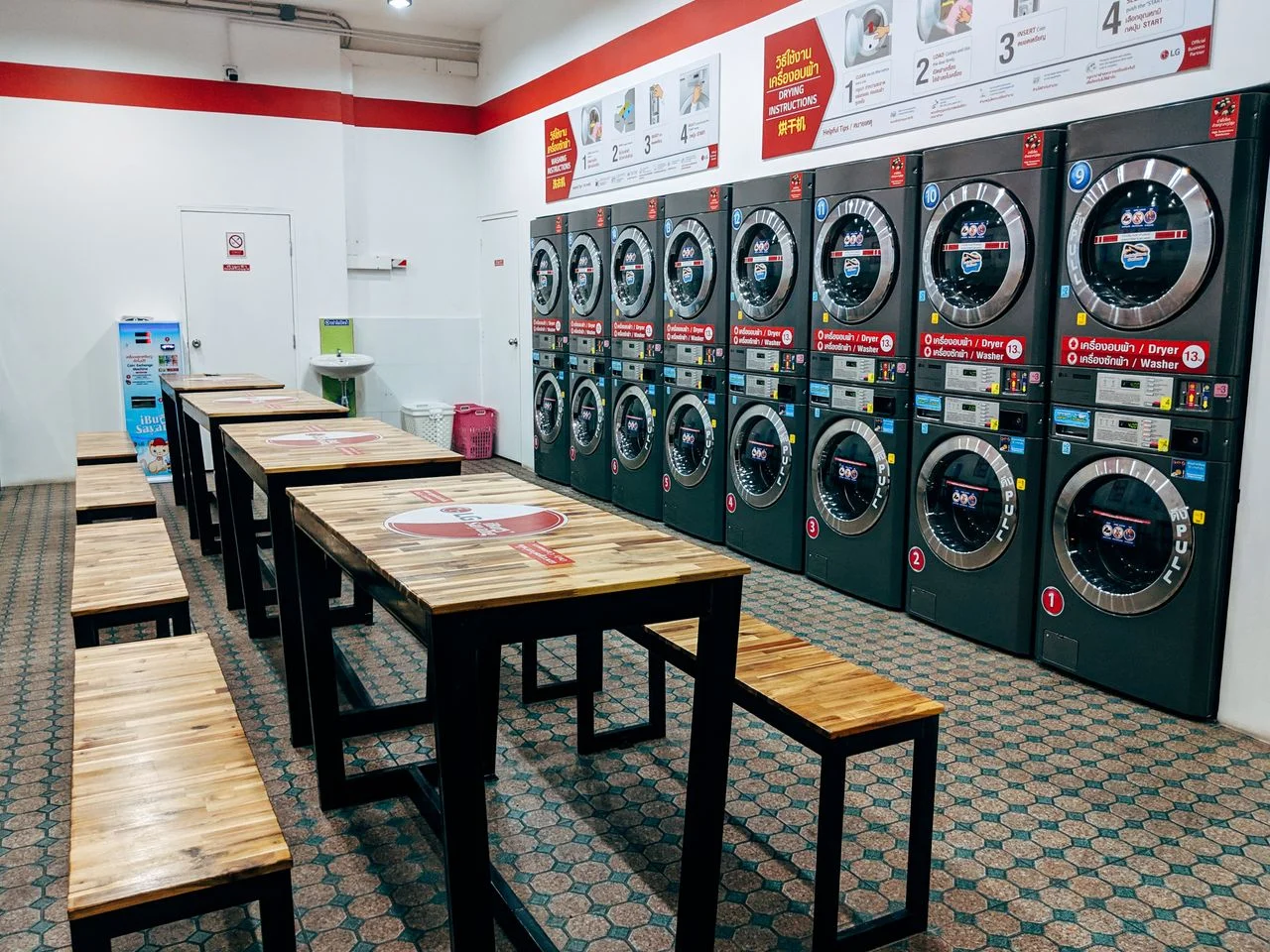
A laundromat sits somewhere between the low-capital service businesses earlier in this series and the real-estate-scale investment of self storage. It’s often marketed as “passive income,” which oversells it. A laundromat is a genuine small business with real equipment, real utility infrastructure, and a meaningful upfront investment, though a well-run one can eventually run with relatively light day-to-day labor once it’s established. Here’s what actually goes into starting one.
What a Laundromat Business Actually Involves
A laundromat provides coin- or card-operated washers and dryers for customers who don’t have (or don’t want to use) in-unit laundry at home. The core business model is straightforward: customers pay per load, the facility handles maintenance and utilities, and revenue comes from machine usage plus, increasingly, add-on services.
Two structural decisions shape everything else: whether you buy an existing laundromat, build new, or convert an existing space; and whether you run a pure self-service model or add staffed services like wash-dry-fold or pickup and delivery.
How Much Does It Actually Cost to Start a Laundromat?
This is the question where laundromat guides disagree with each other the most, mainly because “starting a laundromat” can mean wildly different projects. It’s worth separating this into tiers rather than quoting one figure.
Buying and retooling an existing, run-down laundromat. This is the lowest-cost entry point, with cash requirements sometimes starting around $50,000 to $100,000 if you’re taking over an existing space and gradually upgrading equipment rather than doing a full buildout. This path is also the most leverageable, meaning outside financing can cover a meaningful share of it.

A mid-size laundromat with a proper commercial buildout. Renovating a space with new commercial-grade machines commonly lands in the $200,000 to $500,000 range, depending on square footage, location, and equipment choices. Small storefront locations tend toward the lower end of that range, larger modern facilities toward the upper end or beyond.
New ground-up construction. This is the most expensive path by a wide margin. Estimates for total project cost on new construction commonly range from around $700,000 up to $1 million or more, with some sources citing figures beginning around $250,000 for smaller new builds and reaching several million for large facilities. Most investors going this route finance roughly 75 percent of the project and bring cash equity somewhere in the $175,000 to $250,000 range.
Equipment itself is a major line item regardless of path. Basic commercial top-load machines can start at relatively low prices, sometimes cited around $1,000 for entry-level units, while modern high-capacity front-load washers can cost considerably more: current equipment estimates put a new 25-pound commercial washer around $5,000, a 40-pound model around $8,000, and a 60-pound machine at roughly $12,000 or more. Commercial stacked dryers commonly run several thousand dollars per unit as well, and a fully equipped facility of any real size routinely runs into six figures for machines alone.
Given how much these figures vary by source, location, and project scope, treat the numbers above as industry estimates rather than an established national average, and get a location-specific quote before committing to a budget.
| Path | Rough Cost Range | Notes |
|---|---|---|
| Buy and retool an existing laundromat | $50,000 – $150,000 | Lowest barrier to entry, most financeable |
| Renovate/build out a mid-size location | $200,000 – $500,000 | Most common path for a proper commercial setup |
| New ground-up construction | $700,000 – $1,000,000+ | Highest cost, longest timeline |
Is a Laundromat Business Profitable?
It can be, and laundromats are often cited as one of the more resilient small-business categories, since demand for laundry access doesn’t disappear in a downturn the way discretionary spending might. That said, precise profitability figures are hard to pin to a reliable nationwide source. Industry advocacy data (from The Laundry Association, the industry’s trade group) indicates individual coin laundries can generate cash flow anywhere from roughly $15,000 to $300,000 a year, but stresses that performance varies significantly by demographics, services offered, rent, utility costs, competition, vend pricing, and equipment. Treat any specific profit-margin or cash-on-cash return percentage you see cited elsewhere as a general benchmark rather than an expected return, since we couldn’t verify a single authoritative figure for either.
Individual store revenue varies enormously for the same reasons, so national industry figures shouldn’t be used to predict what a specific location will earn. For reference, The Laundry Association reports roughly 29,500 coin laundries operating in the US generating nearly $5 billion in combined annual gross revenue, which gives a sense of scale for the industry as a whole without saying much about any one location. None of this is close to fully passive, regardless of where a given store lands in that range. A laundromat still requires regular equipment maintenance, cleaning, cash collection (unless you’re fully card/app-based), and customer issue handling, more if you’re staffing wash-dry-fold or delivery services on top of the self-service side.
Licensing and Permits: The Part Most Guides Undersell
Here’s the good news first: laundromats generally don’t require a professional credential or trade exam the way, say, HVAC contracting does. That’s genuinely different from most licensed trades. But it would be inaccurate to say no state or jurisdiction has any laundromat-specific licensing requirement at all. Washington, DC, for example, includes coin-operated and commercial laundry within its business licensing system, while New York City actually repealed a specific Retail Laundry License requirement back in 2021, illustrating exactly why local rules vary and why a nationwide claim doesn’t hold up. Check your specific state, county, and city requirements rather than assuming a national standard applies.
The less convenient reality is that the permitting and buildout process is where laundromat projects most often run into delays and underestimated costs, precisely because there’s no single licensing checklist to follow. What you’ll typically need to look into includes:
- A local business license, with cost and requirements depending on your specific city, county, and the issuing agency, so there’s no reliable single nationwide figure to budget against
- A certificate of occupancy confirming the space is approved for commercial laundry use
- Building permits for electrical, plumbing, and gas work, since laundromats require commercial-grade utility capacity that most retail spaces weren’t originally built for
- Wastewater discharge requirements from your local sewer authority. Depending on your jurisdiction and the nature or volume of your discharge, this could mean anything from a simple registration to a formal pretreatment or discharge permit. There’s no single national standard here (a proposed federal rule for industrial laundries was actually withdrawn in 1999), so confirm directly with your local utility before committing to a site, not after.
- ADA compliance. Laundromats open to the public are subject to ADA requirements. New construction and renovations must meet accessible design standards, including a specified number of accessible washers and dryers along with accessible routes, reach, and controls. This isn’t limited to new construction, either: existing facilities can also have an obligation to remove architectural barriers where doing so is “readily achievable,” so this applies even if you’re taking over an existing space rather than building new.
This utility and construction-permitting work, not a licensing exam, is genuinely the hardest part of opening a laundromat in most places. Confirming your prospective location’s existing electrical, water, and sewer capacity before you sign a lease can save you from discovering a very expensive infrastructure problem after you’re already committed to the space.
Choosing a Location
Location is arguably the single biggest driver of a laundromat’s long-term success, more so than most of the other business types in this series. Because laundromats draw heavily from their immediate surrounding neighborhood rather than pulling customers from across a city, demographic conditions within a tight trade area matter enormously, more than they would for a business people are willing to drive further for.
Key things to research for a prospective location:
- Renter concentration in the surrounding area. Homeowners are far less likely to be regular laundromat customers than renters without in-unit laundry, so look for a strong concentration of renter-occupied households, particularly ones without convenient in-unit laundry, rather than targeting a specific percentage as a hard rule.
- Household income and housing type. Analyze income alongside renter concentration, housing type, vehicle access, and household size rather than relying on a single income cutoff. Older industry survey data has pointed to lower-to-moderate household income as a common characteristic of self-service laundry customers, but this varies significantly by city and shouldn’t be treated as a fixed nationwide benchmark.
- Existing competition within a mile. Given how localized the customer base is, a saturated mile radius is a real risk to model before committing.
- Population density. More potential customers within realistic walking or short driving distance directly supports higher machine utilization.
Self-Service vs. Full-Service: Choosing Your Model
Pure self-service is the traditional model: customers do their own washing and drying, and the business is mostly about maintaining machines and collecting revenue.
Wash-dry-fold service, where customers drop off laundry and staff handle it, is increasingly common as an add-on rather than a replacement. It can create a meaningful additional revenue stream and increase revenue per customer, though results vary substantially by pricing, staffing, local demand, throughput, and competition, so treat any specific percentage uplift you see cited elsewhere with caution rather than as a guaranteed outcome. It does require staffing, though, which changes your labor cost structure and moves the business further from the “passive income” reputation.
Pickup and delivery is a further extension of the wash-dry-fold model, appealing to a different, more convenience-focused customer segment, and some laundromats also partner with local dry cleaners to offer drop-off dry cleaning without operating that equipment themselves.
Most successful modern laundromats blend self-service machines as the core with wash-dry-fold as a meaningful revenue add-on, rather than picking one model exclusively.
Financing Your Laundromat
Because of the capital involved, most laundromat owners use some combination of personal savings and financing rather than paying entirely in cash. Equipment financing is commonly available specifically for laundry machines, since the equipment itself can serve as collateral. Financing structures vary considerably by lender, borrower qualifications, project type, and collateral, so there’s no single nationwide formula. For the buy-and-retool path, a smaller cash requirement (in the tens of thousands) is achievable, while new construction typically involves financing a larger share of the project, with one industry advisory source citing roughly 75 percent as a common financed portion, though this varies by deal. SBA-backed loan programs may also be an option for qualifying US borrowers: 7(a) loans can fund acquisitions, construction, equipment, and working capital, while 504 loan structures typically split financing between a senior lender, a CDC/SBA-backed portion, and borrower equity of roughly 10 percent or more under the standard structure, though the exact split depends on the deal.
Whichever path you take, lenders and equipment financiers will want to see a real business plan built around the location-specific demographic and competition research described above, not just a general industry pitch.
Frequently Asked Questions
How much does it cost to open a laundromat? It depends heavily on your path, and the figures below should be treated as industry estimates rather than a fixed national average. Buying and retooling an existing, run-down laundromat can start around $50,000 to $100,000, a mid-size commercial buildout commonly runs $200,000 to $500,000, and new ground-up construction often runs from around $700,000 to $1 million or more. Get a location-specific quote before budgeting, since utility infrastructure needs can shift costs substantially.
Do I need a special license to open a laundromat? Generally no professional credential or trade exam is required, which is different from many licensed trades. That said, some jurisdictions (Washington, DC, for example) do include laundry businesses in their local licensing systems, so don’t assume no license requirement exists anywhere. You’ll typically need a standard business license, a certificate of occupancy, and building permits for electrical, plumbing, and gas work, plus possible wastewater discharge requirements, so check your specific state, county, and city rather than relying on a national assumption.
Is a laundromat business profitable? It can be, though reliable nationwide profit-margin figures are hard to pin down. Industry advocacy data suggests individual coin laundries can generate cash flow anywhere from roughly $15,000 to $300,000 a year, with performance varying enormously by location, rent, utilities, competition, and equipment. Treat any specific percentage return you see cited as a general benchmark rather than an expected outcome for your own location.
Is a laundromat really passive income? Not fully. It requires less day-to-day involvement than many small businesses once established, but still needs regular maintenance, cash collection or app management, cleaning, and customer issue handling, more if you add staffed services like wash-dry-fold.
What makes a good laundromat location? A strong concentration of renter-occupied households (particularly ones without in-unit laundry), household income and housing type that fit your local market rather than a fixed nationwide number, limited existing competition within about a mile, and enough population density to support consistent machine utilization.
Laundromats sit closer to the capital-intensive end of this series, well above photography or bookkeeping but generally below the self storage business model in typical project size. If you’re weighing capital requirements across options, our guides on how to start a junk removal business and a bookkeeping business cover the lower end of that range.
