










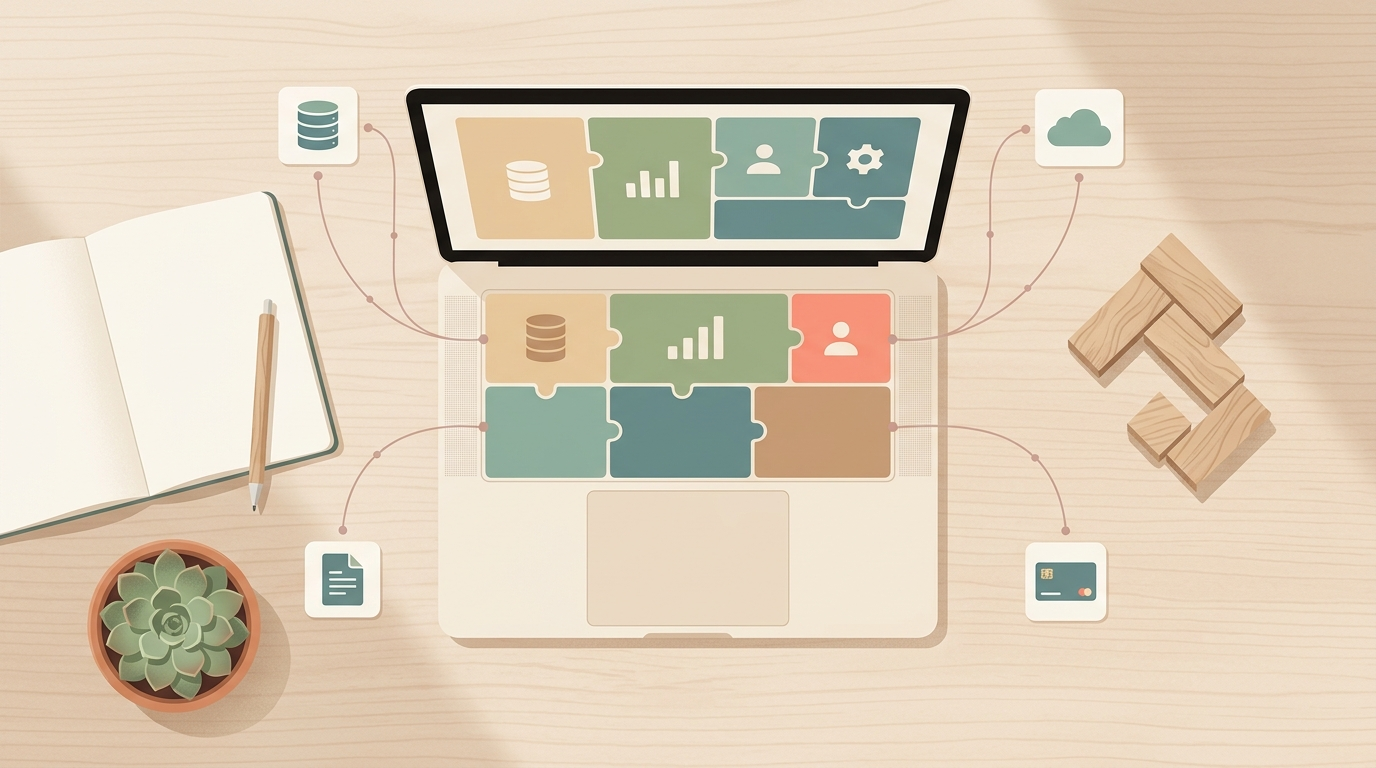
Most large organizations run dozens, sometimes hundreds, of separate software systems. Banks, hospitals, insurers, and government agencies all depend on a patchwork of tools that were built at different times by different vendors. Getting those systems to work together without starting over is one of the biggest challenges in enterprise IT, and it is exactly the problem a composite application framework is designed to solve.
A composite application framework is a set of architecture, tools, and integration methods that lets developers build a new application by combining existing applications, services, and data sources instead of writing everything from scratch. Think of it like building with ready-made blocks. The blocks already exist, and the framework helps you assemble them into something new.
What Is a Composite Application Framework?
The idea rests on a simple concept called a composite application, which is software built by combining functions that already exist elsewhere. Those functions might be a module pulled from an ERP system, a web service from a payment provider, or a report from a legacy database. The composite application wraps them in new business logic and a single user interface, so people experience one application even though many systems are doing the work behind the scenes.
A composite application framework provides the structure that makes this practical. It handles how components connect, how information moves between them, how business rules are applied, and how the result is presented to users. If you want a deeper technical background on the underlying concept, the composite application entry on Wikipedia is a solid starting point.
It helps to know that composite applications are often associated with service-oriented architecture (SOA), but they are not limited to it. They can be built on many different technologies and architectural styles, which is one reason the approach has stayed relevant as technology has changed.
The Specific Meaning of the Term in SAP Environments
You may also run into the phrase in a narrower, vendor-specific sense. SAP used “Composite Application Framework,” often shortened to CAF, as the name of a model-driven toolset for building the business logic layer of composite applications within its NetWeaver Composition Environment. SAP’s own documentation describes composite applications as applications that sit on top of existing enterprise systems and reuse their functionality to support new business processes.
That product line reflects an earlier era of enterprise SOA, so if you are researching modern projects, the general architectural meaning is the one you will see most often today. Still, knowing about the SAP usage helps when you read older documentation or work with teams that have been running SAP landscapes for years.
Why a Composite Application Framework Matters Today
Companies everywhere are adopting cloud platforms, automation, and artificial intelligence, yet many still depend on older systems that hold valuable business data. Replacing all of that software is expensive, risky, and slow. A full replacement can take years and disrupt daily operations along the way.
A composite application framework offers a more gradual path. Organizations can keep the systems that work well, connect them, and add new capabilities on top. Picture a large retail bank that already has a customer relationship management platform, a payment processing system, a fraud detection tool, a loan management application, and a document management solution. Rather than building a brand-new banking platform, developers can combine those systems into one dashboard for employees or one app for customers. The bank modernizes step by step while its reliable systems keep running.
How a Composite Application Framework Works
Although the details vary by vendor and project, most composite applications follow a layered structure. Each layer has a clear job, and keeping them separate is what makes the whole approach flexible.
The Foundation of Existing Applications and Services
Everything starts with the software the organization already owns. That usually includes enterprise resource planning (ERP) platforms, customer relationship management (CRM) systems, databases, cloud applications, older legacy software, and outside business services. These systems often operate in isolation, and the framework’s job is to connect them without forcing major changes to how they run.
The Integration Layer
The integration layer is the communication bridge between systems. It commonly relies on APIs (application programming interfaces), web services, and middleware platforms. Older SOA-style environments often used enterprise service buses, while newer cloud-based projects tend to lean on APIs and microservices. Whatever the technology, the goal is the same, which is to let separate systems exchange information securely and reliably.
Consider a customer applying for a loan online. Behind that single form, a composite application might pull data from an identity verification service, a credit bureau, internal financial records, and the customer’s existing profile, all within seconds.
The Business Logic Layer
This layer decides how the components work together. It holds the rules, workflows, data processing steps, and automated decisions that turn separate services into a coherent process. An insurance company, for example, could combine customer records, risk assessment tools, and payment systems into a single claims processing application, with the business logic layer controlling the order of steps and the conditions for approval.
The User Interface Layer
The top layer is what people actually see. It might be an employee dashboard, a customer portal, or a mobile app. The important point is that users interact with one clean interface and never need to know how many systems are cooperating underneath.
Key Benefits of a Composite Application Framework
The most cited advantage is speed. Traditional development means building every feature from the ground up, while a composite approach reuses services that already work. That can shorten the time it takes to launch a new digital service, since teams are not waiting on a full system replacement.
Cost is another draw. Reusing existing technology and extending current applications usually costs less than replacing them, and it protects the money already invested in those systems. The savings are not automatic, though, and they depend on how clean the underlying systems and their interfaces are.
Integration itself is a benefit. When disconnected systems can share information, teams stop re-entering data and stop switching between screens. A hospital, for instance, can bring together patient records, appointment scheduling, lab results, and billing so clinicians and administrators see a complete picture in one place.
Flexibility follows from the layered design. Because business logic, integration, and interface are kept apart, teams can often add a feature or connect a new service without rebuilding the whole platform. That matters when a company launches a new product or changes a process and needs its software to keep up.
Finally, users get a better experience. Employees and customers generally prefer one simple interface over five separate logins, and a composite application makes that possible.
Real-World Examples
Banking and financial services are among the clearest examples. A modern banking app may combine customer information systems, online banking, payment processing, fraud monitoring, and credit evaluation tools. Customers see one app, while many systems work together behind it. Because payment card data is involved, teams in this space also have to design around requirements such as the Payment Card Industry Data Security Standard (PCI DSS).
Healthcare organizations manage enormous amounts of information across electronic health records, imaging systems, lab platforms, insurance data, and scheduling tools. A composite application can bring these together in a unified view for doctors and staff. Any such project has to protect patient information in line with HIPAA, and standardized APIs, particularly those based on the FHIR standard, have made connecting health systems considerably more practical than it used to be.
Government agencies often run complex systems built over decades. A citizen service portal might combine identity verification, application processing, payment services, and document management behind a single sign-in, so residents complete a task in one place instead of visiting several separate sites.
Manufacturers and supply chain teams juggle production planning, inventory, logistics, quality control, and supplier management. Connecting those systems through a composite application can give managers real-time visibility across operations.
Composite Applications vs. Traditional Development vs. Microservices
Traditional application development usually means designing and building a complete new system. That gives you full control, but it takes longer and often duplicates functionality the company already has. A composite application framework takes the opposite approach, starting from what exists and assembling it into something new. It tends to be quicker for large organizations with heavy investments in enterprise software, though it can be limited by the quality and design of the systems underneath.
Microservices are often confused with composite applications, but they solve a different problem. Microservices break a single application into small, independent services that can be built, deployed, and scaled separately. A composite application does the reverse by combining existing pieces into one experience. The two work well together, since microservices frequently supply the building blocks that a composite application assembles.
Challenges and Risks to Plan For
A composite application is only as dependable as the systems it relies on. If one underlying service slows down or goes offline, the whole application can suffer, so monitoring and fallback planning matter a great deal.
Security and governance also need careful attention. When many systems share data, each connection becomes something to protect. Guidance such as NIST’s Security Strategies for Microservices-based Application Systems covers practices like authentication, access control, and secure service-to-service communication that apply to API-driven designs of this kind.
Other common hurdles include inconsistent data across systems, aging interfaces that were never designed for outside connections, and the ongoing work of maintaining every integration as the connected systems change. Teams that document their services, agree on data standards early, and test integrations regularly tend to avoid the worst surprises.
The Role of Cloud Computing
Cloud computing has made the composite approach easier to adopt. Modern environments are built around APIs, software-as-a-service applications, serverless functions, and microservices, which are exactly the kinds of parts a composite application likes to assemble. A company might combine a cloud customer management platform, an AI service, a payment solution, and an analytics tool into one customer experience without hosting most of it themselves. The same shift affects everyday collaboration, since distributed teams now lean on video conferencing and other SaaS tools every day. If your team meets online, our guide to virtual meeting etiquette covers the habits that keep those sessions productive.
The Future of the Composite Application Framework
The core idea is now part of a broader movement often called composable enterprise architecture, a term popularized by research firm Gartner. In this model, businesses assemble their capabilities from flexible, reusable components instead of relying on large, fixed systems.
Artificial intelligence is likely to play a growing part. AI assistants could pull information from several enterprise systems at once and suggest next steps, and AI tools may help teams map and connect systems faster. If you want to see what today’s assistants can already do, our roundup of free AI tools for marketing is a practical place to start. Low-code and no-code platforms are also opening the assembly process to business teams through visual tools. APIs will remain central, since they are how organizations securely share data with partners and internal teams alike. And more composite applications will be designed for the cloud from the start, using containers, microservices, and automated deployment to scale more easily.
Frequently Asked Questions
What is a composite application framework?
A composite application framework is a software architecture approach that lets developers combine existing applications, services, and data sources into a single integrated application. In SAP environments, CAF is also the name of a specific toolset for building the business logic of composite applications.
Why do companies use a composite application framework?
Companies use one to reuse existing systems, reduce development effort, improve integration between tools, and build flexible digital solutions without replacing everything they own.
Is a composite application framework the same as an API?
No. An API is one technology used inside composite applications. The framework covers the broader architecture, integration methods, and processes needed to combine multiple systems.
Which industries use composite applications?
They are common in banking, healthcare, government, manufacturing, retail, telecommunications, and enterprise software.
Are composite applications replacing traditional software?
Not really. They usually extend and connect existing software rather than replace it.
How is a composite application different from microservices?
Microservices split one application into small independent services. A composite application combines existing services and systems into one experience. Many composite applications are built from microservices.
What technologies support a composite application framework?
Common examples include APIs, web services, middleware, cloud platforms, microservices, and enterprise integration tools.
Conclusion
A composite application framework gives organizations a practical way to build modern digital solutions from the systems they already have. Instead of rebuilding their technology from scratch, businesses can connect current investments into flexible, scalable applications, as long as they plan for the security, reliability, and maintenance work that comes with linking many systems together. As cloud computing, AI, and automation keep reshaping enterprise software, the composite application framework will remain a useful approach for building connected and adaptable solutions.
