









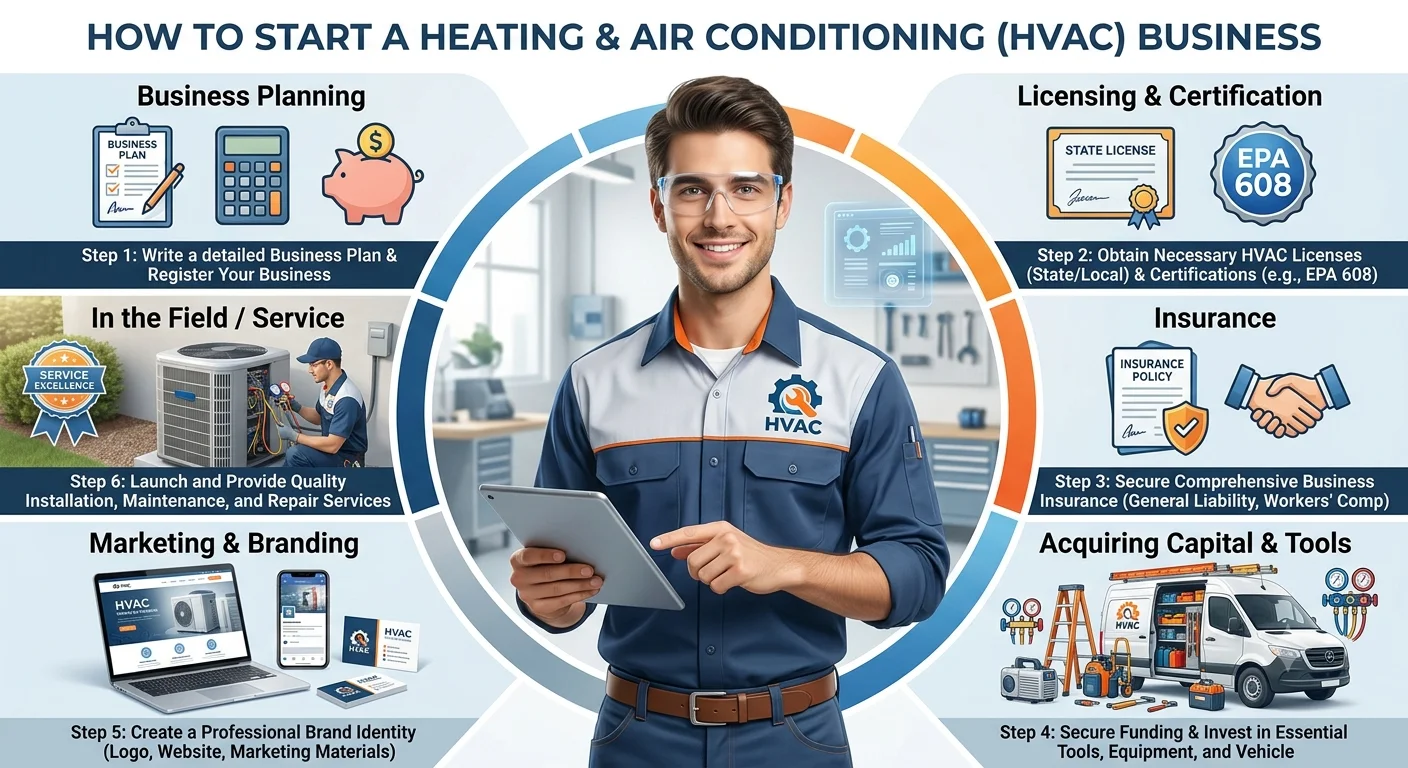
Learning how to start a heating and air conditioning business comes down to five steps: getting certified and licensed, choosing your service focus, handling insurance and legal setup, pricing your services correctly, and marketing yourself in your local area. Unlike many small businesses, HVAC work is a licensed trade in most places, so the certification step generally isn’t optional. Here’s how to work through each stage.
Get certified and licensed
This is the one section in this guide that isn’t flexible. Anyone who personally installs, services, repairs, or disposes of HVAC equipment in a way that could release refrigerant generally needs EPA Section 608 certification. Depending on your location, you may also need a state, county, or municipal HVAC or mechanical-contractor license on top of that.
EPA Section 608 certification. This is a technician certification, not a business-owner license. If you’ll personally be installing, servicing, or disposing of equipment that contains refrigerant, you need it. A business owner who doesn’t perform that work directly can instead employ appropriately certified technicians. Certification has multiple types (Type I for small appliances, Type II for high-pressure systems, Type III for low-pressure systems, and Universal covering all three), so choose the type that matches the systems involved.
State and local contractor licensing. Requirements vary significantly by state and sometimes by city or county, and licensing may occur at the state, county, or municipal level depending on the work and location. Some states require a dedicated HVAC contractor license with its own exam, work-hour requirements, and continuing education. Others fold HVAC work under a general contractor license. Check your specific state licensing board before assuming any particular requirement applies nationwide.
Apprenticeship or trade school. If you’re not yet certified, a trade school program or a formal apprenticeship (often through a union or trade association) is the standard path in. Many states require a documented number of hours working under a licensed technician before you can sit for your own contractor exam.

Because licensing rules change and vary so much by location, treat this section as a starting point, not a substitute for checking your own state’s contractor licensing board directly.
Starting an HVAC business in California. California is one of the stricter states here. Beyond EPA 608 certification for anyone doing the refrigerant work, you’ll generally need a C-20 Warm-Air Heating, Ventilating and Air-Conditioning contractor license from the Contractors State License Board (CSLB). That typically requires four years of qualifying journey-level or higher experience (education or apprenticeship training can count for up to three of those years), plus passing a Law and Business exam and the relevant trade exam, unless you qualify for a waiver.
California C-20 contractors must also maintain a $25,000 contractor bond, and must carry workers’ compensation insurance even with no employees, so factor that into your startup budget as a solo operator. A California LLC contractor license also generally requires an additional $100,000 employee/worker bond on top of the standard contractor bond. If you plan to work in California specifically, budget extra time for licensing and check the CSLB site directly, since requirements are updated periodically.
Choose your service focus
Once you’re certified, decide what kind of HVAC work you actually want to build a business around.
- Residential vs. commercial. Residential work tends to involve shorter, more frequent jobs. Commercial contracts can pay more per job but may require more capital and, depending on the systems involved, more specialized certification.
- Installation vs. repair and maintenance. Installation work is generally more capital-intensive and, depending on your market, can carry a higher margin per job. Repair and maintenance work tends to build recurring relationships and steadier demand.
- New construction vs. service calls. New construction ties you to builders and larger contracts. Service calls are more independent but require strong local marketing to stay booked.
- A specialty niche, such as energy-efficient systems, smart thermostat installation, or a specific brand certification, can help you stand out once you have a service focus established.
Write an HVAC business plan
A simple one-page plan is enough to start, and it should cover:
- Startup costs. Tools, a service vehicle, insurance, licensing and certification fees, and initial marketing.
- Service area. How far you’re willing to travel for a service call, and where your competition is concentrated.
- Target customer. Homeowners, property managers, small commercial clients, or a mix.
- Break-even point. How many service calls or installations per month you need to cover your costs.
Handle insurance, bonding, and legal setup
HVAC work carries real liability exposure (gas lines, electrical connections, refrigerant handling), so this section matters more here than it does for lower-risk businesses.
Business structure. Consider whether an LLC, corporation, partnership, or sole proprietorship best fits your circumstances. An LLC can provide personal-liability protection in many situations given the liability exposure in this trade, but it doesn’t replace appropriate business insurance, and in some states (California among them) it can come with additional licensing or bonding costs.
General liability insurance. Covers property damage or injury that happens as a result of your work. Most commercial clients and many residential customers will ask to see proof of insurance before hiring you.
Workers’ compensation. Requirements vary by state. Many employers must obtain coverage once they hire an employee, while certain contractor classifications or states (California’s C-20 license, for example) may require coverage even for businesses with no employees.
Contractor’s bond. Some state and local licensing authorities require HVAC contractors to carry a surety bond as a condition of licensing. It protects customers if you fail to complete a job as agreed.
Get the right tools and a service vehicle
A starting HVAC technician typically needs:
- Core diagnostic and installation tools (multimeter, refrigerant gauges, vacuum pump, recovery machine)
- Basic hand tools and a starter set of common replacement parts
- A reliable service vehicle, since most jobs require transporting tools and equipment on-site
- Safety equipment appropriate to gas and electrical work
For a new business, leasing a van and financing larger equipment can be more manageable than buying everything outright in year one, depending on your cash position. Reserve outright purchases for the tools you’ll use on nearly every job.
Price your HVAC services
Flat-rate pricing. Common for standard jobs like a tune-up or a specific repair, since customers know the cost upfront and it protects you if the job goes faster than expected.
Hourly pricing. More common for diagnostic work or unpredictable repairs, where the scope isn’t clear until you’re on-site.
Maintenance plans. A recurring seasonal maintenance contract is one of the most valuable things an HVAC business can sell, since it creates predictable revenue and keeps you top of mind when a bigger repair or installation comes up.
Whichever model you use, build your rates around a real break-even calculation: labor, drive time, tool wear, insurance, and licensing costs all factor in, not just the part cost.
Market your HVAC business locally
Google Business Profile and local SEO. HVAC searches are highly local and highly urgent (“AC repair near me” spikes hard in summer), so a complete, review-rich Google Business Profile is one of the highest-leverage things you can set up.
Vehicle branding. A clearly branded van doing service calls around town can function as ongoing local advertising for little added cost beyond the initial wrap or signage.
Referral relationships. Realtors, property managers, and home inspectors regularly need a reliable HVAC contractor to refer clients to, and a handful of those relationships can produce steady work.
Land your first customers
- Ask for reviews after every job. HVAC customers rely heavily on reviews given the urgency and cost involved, so early reviews matter disproportionately.
- Time your launch around seasonal demand in your area. In most U.S. climates, demand tends to pick up before the cooling and heating seasons, but the exact timing depends on your local climate, so check when searches and service calls typically spike in your specific market.
- Offer a maintenance plan promotion for your first customers to build recurring revenue early rather than relying only on one-off jobs.
HVAC business startup checklist
A quick recap you can work through in order:
- Get EPA Section 608 certified for the refrigerant types you’ll handle
- Complete your state’s HVAC contractor licensing requirements (check your state board, and CSLB specifically if you’re in California)
- Choose your service focus (residential, commercial, installation, repair, or a niche)
- Write a one-page business plan covering startup costs, service area, and target customer
- Choose a business structure that fits your situation and get general liability insurance
- Get workers’ comp and a contractor’s bond if your state or license type requires them
- Buy or lease your core tools and a service vehicle
- Set your pricing model and calculate your break-even rate
- Set up your Google Business Profile and local SEO basics
- Line up your first few customers through friends, referrals, or a launch promotion
Frequently asked questions
How much does it cost to start an HVAC business?
Startup costs vary substantially based on whether you already own tools and a suitable vehicle, your licensing and insurance requirements, and whether you’re starting alone or hiring employees. Rather than relying on a single national average, build an itemized estimate covering certification, licensing, bonds, insurance, tools, inventory, a service vehicle, marketing, and several months of working capital.
Do I need a license to start an HVAC business?
you’ll personally be doing refrigerant-related work, you’ll need EPA Section 608 certification. Depending on your location, you may also need a state, county, or municipal HVAC or mechanical-contractor license. Requirements vary by jurisdiction, so check your specific licensing board rather than assuming a national standard applies.
What licenses are needed to start an HVAC business?
Commonly required items include EPA Section 608 certification for anyone doing refrigerant work, a state or local HVAC contractor license (such as California’s C-20 license), any required state or local business registrations, and in some jurisdictions a contractor’s bond. The exact combination depends on your location and the type of work you plan to do, so confirm specifics with your local licensing authority.
How much can you make owning an HVAC business?
Owner earnings vary substantially by location, pricing, billable hours, overhead, staffing, and service mix. Gross business revenue isn’t the same as the owner’s salary or net profit. It’s worth forecasting revenue from realistic local job volume, then subtracting labor, vehicle, equipment, insurance, marketing, taxes, and other operating costs to estimate actual take-home pay.
Do I need HVAC experience before starting my own business?
In most cases, yes. Beyond certification requirements, many states require documented hours working under a licensed technician (California’s C-20 license, for example, generally requires four years of qualifying experience) before you can hold your own contractor license. Check your specific state’s requirements, since the amount of required experience varies.
